Posts

Online Instruction: Teaching the Learners and the Teachers

Image
I think that our goal as instructors is to take the best aspects of objectivism, constructivism, and connectivism, discussed by Bates in Teaching the Digital Age , and apply those the courses we teach. I discussed some of the positive aspects of lecturing in my previous post, and how those could be brought into an online environment, both asynchronously and synchronously, with tools such as live webcasts, video recordings, and media produced by experts in the respective field (I think of how often I have viewed TED talks in my course work in the DLL program.) I spoke in my literature review about bridging the gap between the LMS and collaborative Web 2.0 tools, and am planning on adding many of the features discussed below to my a course I am developing in Canvas LMS: Figure 7.7 from Teaching the Digital Age by Tony Bates (2015) Adding social networking features to LMS would allow students to collaborate more easily in real time due to social media availability on mobile devic...

Lecturers and Cognitive Overload

Image
There has been a lot of discussion over the place of lecturer in the classroom, especially in the digital age, when there are so many other possible learning activities that are available due to technology. One thing that we need to remember is that not all lectures are the same; lecturing and can vary in how engaging and useful it is to students. Students themselves have been found to strongly correlate lecturing with their own perception of learning: this definitely is a fact that has pluses and minuses. Research has found that students show a high preference for the hybrid environment compared to the online learning environment, and a lot of that is due to a preference for face-to-face interaction with the instructor, lecturing being a large aspect of that. In my practice as an science educator at the high school level, I did use lecturing as a way to convey information, such as at the beginning of unit, to provide detailed instructions for another activity, and modelling activit...

Thoughts on Teaching and Learning

Image
For a five week online course I am developing as a student in an Instructional Design in Online Learning course, I am planning on implementing some of the ideas I discussed in my innovation plan and researched for my literature review "Interactivity and Collaboration in Learning Management Systems: An Analysis to Support an Action Research Plan". My plan was to integrate more collaboration and interactive Web 2.0 tools into the curriculum for a mandatory undergraduate course (EDUC 1300 - Learning Framework). As this course is offered at the college during summer 5 week sessions, I thought it would be a great opportunity to basically build the course as I have imagined it in the innovation plan, using the same Canvas LMS and course outcomes as the institution. While I have not had the opportunity to teach an online course, I have used some flipped classroom activities while teaching, and led some hybrid professional development activities. As is have progressed through my...

Examining Seven Life Skills

Image
Innovation strategies depend not on reinventing the wheel, but on implementing the strategies into existing educational frameworks. I think that as agents of innovation, we as educators are trying to achieve most of the same goals as as the ones laid out by our organizations, but are advocating “new and improved” ways of doing so. The lists of skills developed respectively by Tony Wagner and Ellen Galinsky, are a great reminder of what we seek to cultivate in the students: education and learning not as an end in and of themselves, but as a way to develop student’s abilities for their lives ahead. Wagner and Galinsky have significant overlap in their seven skills, but each of them do have several unique features. I used a graphic organizer to compare each list of seven skills and was able to identify three major areas where they overlapped: - Communication - Wagner emphasizes developing voice, while Galinsky discusses communicating a message that is designed to reach a target audien...

Leading Organizational Change

Image
As part of my coursework in  Leading Organizational Change at Lamar University , I e xplored current leadership theories and practices for digital learning and institutional change in educational systems. Our course learning goal was to equip ourselves to be differentiated leaders who can address the inevitable resistance to change that will occur when launching innovative digital learning initiatives. Our first step was to identify and articulate the “Why”, which is the key vision or purpose for the change that is required in our organizations and assess the motivation needed to support these changes. I blogged about the process of determining my “Why” and reimagining my innovation plan for my current professional role in higher education. The question of “Why?” is important in change efforts and in learning in general, because this addresses our motivations and the emotions behind them. This “Why?” should be a “hook” that makes the audience more...

Reimagining my Innovation Plan and the Why?

Image
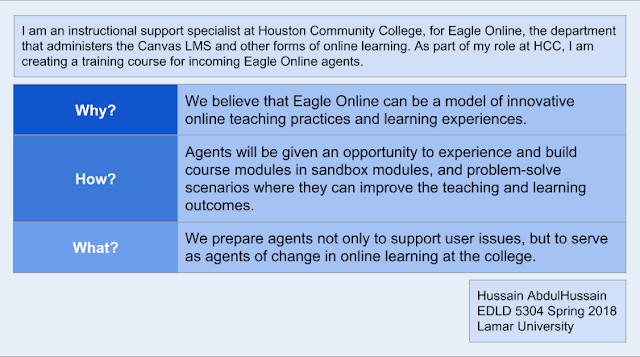
As a student in the DLL program at Lamar , an innovation plan and its implementation in the setting of my professional organization are a big part of the learning and leading activities of my coursework. However, I have undergone a change in my professional role since I entered the DLL program: I had been a high school teacher for 8 years, but felt that I wanted a chance to explore other opportunities in the education field and realized that this was the right time and the right program to take the plunge into getting the graduate degree I had been planning on. I didn't feel like I would be able to do my best in the roles of classroom teacher and graduate student simultaneously, so I decided to take a break from K-12 education. I currently work as an instructional support specialist at Houston Community College, in the Distance Education department, which administers the LMS. It is definitely interesting to be enrolled in a 100% online degree and at the same time also get a behind ...

Visions for Change in Education

The idea of being an innovative educator can seem intimidating because those words create the perception that you have to implement extremely elaborate and ambitious educational program to be one. However, I think an educator can practice innovation just by taking some small steps to improve teaching and learning experiences; by keeping this in mind, I think I am on my way to becoming an innovative educator. I try to not stick to the traditional “sage on the stage” lecture model and give students more opportunities to be responsible for their own learning, whether it is by incorporating technology, doing a hands-on-activity or collaborating with their peers. One challenge of working for large organizations is that it is difficult to make significant changes in educational practices because of the large number of people that are involved in the process; it can be difficult to get everyone on board. This often results in doing things the way that they have always been done, and student...